
A Venetian plaster contractor is a specialist in hand-applied lime and marble finishes — not a painter with an extra product on the truck. The skills, tools, materials, and process are categorically different, and hiring the wrong person doesn’t just waste money — it leaves you with walls that need to be stripped and redone.
What does a Venetian plaster contractor actually do (and why it’s not like hiring a painter)?
A Venetian plaster contractor applies decorative lime-based finishes by hand — multiple coats, each worked and compressed with a steel trowel — to build depth, translucency, and surface hardness that paint simply cannot replicate. This is a craft. It takes real time to learn and real skill to execute consistently.
Stucco veneziano, marmorino, grassello di calce — these aren’t product names you slap on with a roller. Each system requires a different trowel technique, a different layering sequence, and a different approach to burnishing. Miss a step, rush a layer, or use the wrong base material and the finish won’t hold. It’ll crack, delaminate, or look flat and lifeless.
Painters are trained to cover surfaces efficiently and uniformly. That’s a completely different goal. A decorative finishes contractor is trained to build a surface — layer by layer — so that the final result has dimension, movement, and a visual quality that shifts with the light. The process for a polished grassello di calce finish alone involves at least three to five trowel passes per layer, then burnishing with a high-pressure steel blade to compress and shine the marble particles. That’s not a painting technique.
I always tell people who’ve gotten a quote from a painter who “also does Venetian plaster”: ask them to show you samples they’ve done in-person, not photos. Ask them what material brand they’re using. Ask them how many coats. Most of the time, the answers make it clear very quickly.
How do I know if a Venetian plaster contractor is qualified?
Look at their samples — physical, in-hand samples — not just photos on a phone screen. A qualified Venetian plaster contractor should be able to show you multiple finish systems in different sheens: polished, satin, matte. If they only have one finish style, that’s a limitation worth noting.
Ask about the materials. A serious contractor works with premium Italian plasters — products from suppliers who formulate specifically for lime-based decorative systems. The material quality matters enormously because grassello di calce and marmorino behave differently from synthetic “Venetian plaster” products sold at big-box stores. Those products can look fine in photos but won’t burnish the same way, won’t breathe the same way, and won’t last as long.
Here’s what to look for in a qualified contractor:
– They can explain the difference between at least two or three plaster systems (marmorino vs. grassello, for example) and when they’d recommend each – They work with Italian-formulated lime plasters, not latex-based “Venetian plaster paint” – They do custom colour development rather than picking from a preset chart – They can speak to surface preparation — because prep is half the job – They understand sealing and can explain what product they use and why for different rooms
In my experience, the contractors who can’t answer those questions clearly are either working from YouTube knowledge or subcontracting the work to someone else. Which brings me to the next point.
What should I expect when I hire a Venetian plaster contractor — start to finish?
When you hire a dedicated decorative finishes studio, the process is structured and collaborative. It doesn’t start with a price — it starts with understanding the space and what you’re trying to achieve.
Here’s what a proper process looks like:
1. Consultation. This is where we talk through the room, the lighting, the existing materials in the space, and what finish direction makes sense. North-facing rooms behave differently from south-facing ones. A highly polished marmorino in a low-light hallway might not perform the way you’re imagining.
2. Custom colour development. A qualified contractor doesn’t hand you a colour fan deck. They develop samples based on your direction — pulling references from materials you like, adjusting pigment ratios, and showing you how the colour reads in different light conditions. This takes time, and it should.
3. Surface preparation. This is the step most people don’t see and the step that matters most for durability. Walls need to be clean, structurally sound, and primed with the right primer for the plaster system being applied. Venetian plaster applied over a compromised surface will fail regardless of how skilled the applicator is.
4. Multi-layer hand application. Most finish systems involve two to four layers of plaster, each applied by hand with a stainless or carbon steel trowel. Each layer needs to be the right consistency, applied at the right thickness, and worked within a specific timing window before it sets up.
5. Burnishing and sealing. Burnishing — compressing the surface under pressure — is what creates the polish and sheen in systems like marmorino and grassello. Different finishes get different treatments. A matte spatolato finish gets very little burnishing. A polished stucco veneziano gets worked repeatedly until the marble particles compress into that glassy, cool surface. Sealing comes last and protects the finish for years.
If a contractor’s process skips or glosses over any of these stages, I’d want to know why before signing anything.
How much does hiring a Venetian plaster contractor in Ottawa cost?
Venetian plaster is a premium artisan finish — it costs more than paint. That’s not a spin; that’s the reality of the labour and materials involved.
I don’t publish per-square-foot rates because the honest answer is that pricing depends on too many variables: which plaster system, how many coats, what condition the substrate is in, how complex the geometry of the space is, whether there’s custom colour work involved. A burnished grassello di calce on a curved feature wall takes considerably more time than the same system on a flat accent wall.
What I will say is this: if you’ve gotten three quotes and one of them is dramatically lower than the others, ask what’s different. Usually it’s the material (synthetic vs. lime-based), the number of coats (two instead of four), or the applicator experience. Sometimes all three. The price gap between a painter doing Venetian plaster on the side and a dedicated decorative finishes studio is real — but so is the skills gap on the other side of it.
For a serious consultation that results in a real scope and a real number, call or email directly. Pricing is done per project, after we’ve seen the space and agreed on the finish system.
Which surfaces and rooms are best suited for Venetian plaster?
Venetian plaster works on almost any interior surface that’s been properly prepared — but some applications are better suited to specific finish systems than others.
Feature walls and accent walls are the most common application. A single polished marmorino wall in a living room or bedroom adds a level of presence that paint can’t touch.
Kitchens and bathrooms are excellent candidates, but they need to be sealed correctly. Lime-based plasters are naturally breathable and antimicrobial, which makes them a smart choice in humid environments — but you need an applicator who understands the right sealer for the environment. A bathroom that gets steam daily needs a different treatment than a powder room.
Fireplaces and fireplace surrounds are one of my favourite applications. The material complements the heat and weight of a fireplace surround in a way that tile or paint simply doesn’t. Make sure the contractor understands the thermal requirements of materials near heat sources.
Commercial spaces — hotel lobbies, restaurant interiors, retail stores, spas — are where Venetian plaster really shows what it can do at scale. A well-executed stucco veneziano wall in a lobby communicates a level of quality that clients notice immediately.
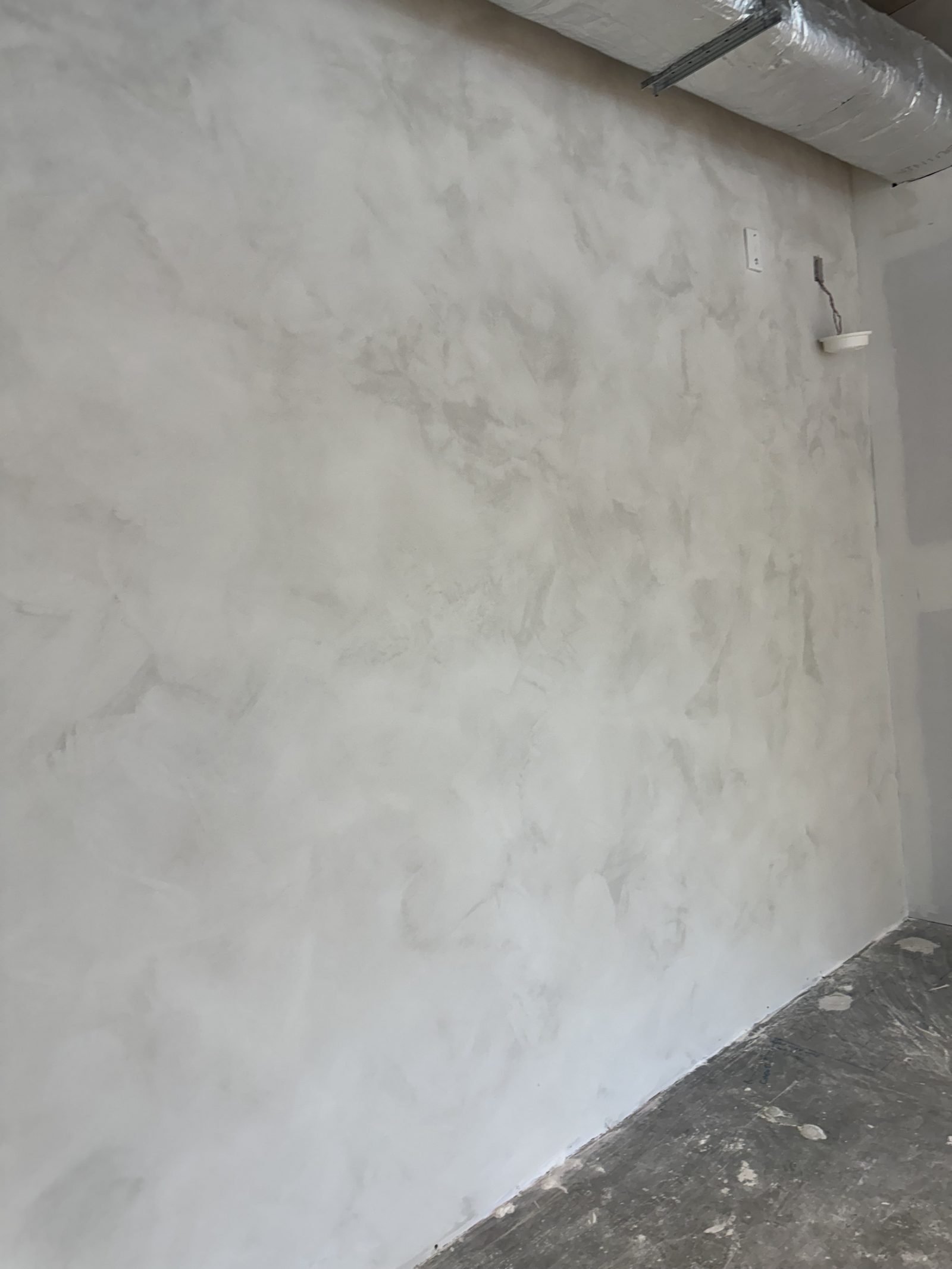
What it’s not ideal for: ceilings without proper preparation and structural soundness, surfaces with significant moisture intrusion from behind, or any substrate that flexes or moves significantly. The plaster will crack if the wall does.
In older Ottawa homes — the Glebe, Sandy Hill, Westboro — you sometimes encounter original lime plaster walls that are ideal substrates because they’re already compatible with lime-based finishes. Modern drywall works too, but the prep approach is different.
Questions to ask before signing with any Venetian plaster contractor
Before you commit to anyone — including me — you should be asking these questions. A contractor worth hiring will answer all of them without hesitation.
– What plaster system are you recommending for this space, and why? – Are you using lime-based Italian plasters or synthetic alternatives? – How many coats does your process include? – Can I see physical samples of this finish, not just photos? – Who is doing the actual application — you, or a subcontractor? – What does your surface prep process look like? – What sealer do you use, and how does it affect the finish’s appearance and durability? – What’s your process if something goes wrong — adhesion failure, cracking, colour mismatch? – Do you have examples of this specific finish in a similar room type?
That last question matters. A marmorino finish that works beautifully in a spa environment might not be what you want in a high-traffic commercial lobby. Experience with your specific application type is worth asking about directly.
If a contractor gets defensive about any of these questions, that’s information. The right contractor understands why you’re asking and welcomes it.
Venetian plaster is one of the most durable, beautiful, and genuinely sustainable wall finishes available — no synthetic resins, no VOCs, breathable lime and marble that lasts decades when applied correctly. But it has to be done right. The material and the technique don’t forgive shortcuts.
If you’re looking at a wall and wondering whether it’s the right fit, or you’ve already gotten quotes that left you with more questions than answers, call me directly at 613-255-1512 or email Info@designerwallfinishes.com. Bring your screenshots, your reference images, your paint chips — whatever you’ve been collecting. I’ll bring the samples. We’ll look at the space together and figure out exactly what system makes sense, what it’ll take, and what it’ll look like before anything goes on the wall.