
Concrete effect plaster is a hand-applied mineral finish — typically microcement or a spatolato-style decorative plaster — that replicates the raw, matte look of poured concrete without any of the structural requirements. Skilled applicators work across Canada, including right here in Ottawa, so getting this done properly isn’t the challenge most people assume it is.
What is concrete effect plaster and how is it different from actual concrete?
Concrete effect plaster is a decorative coating, not a structural material. That distinction matters more than people realize. Real poured concrete is heavy, requires formwork, can crack with building movement, and is cold and porous without serious sealing work. Concrete effect plaster — typically microcemento or a polymer-modified mineral finish — goes on over your existing walls, floors, or ceilings at just a few millimetres thick.
The result looks nearly identical to polished or raw concrete: the same cool grey tones, the same subtle tonal variation, the same urban-industrial feel. But because it’s hand-applied in thin layers with a steel trowel, the applicator has complete control over texture, depth, and colour. You can dial it toward a raw industrial slab or a smoother, more refined finish depending on what the space calls for.
The material itself is usually cement-based with added polymers and a finishing sealer. Some systems are fully mineral. Either way, the weight on your walls is negligible compared to actual concrete, and there’s no structural engineer needed.
Is microcement waterproof enough for bathrooms and kitchens in Canada?
Yes — when it’s applied correctly and sealed properly, microcement handles wet environments well. The finish itself isn’t inherently waterproof (cement is porous), but a quality topcoat sealer is what closes the system. Most professional-grade microcement systems use a two- or three-part polyurethane or epoxy-modified sealer that makes the surface highly water-resistant.
In a bathroom, I’d always recommend a minimum of two coats of sealer, with particular attention to the shower enclosure and anywhere water pools regularly. In a kitchen, splashback areas need the same treatment. The sealer is what takes a good concrete finish and makes it liveable.
Canada’s climate adds one variable worth knowing: interior humidity swings between our dry winters and humid summers can cause minor substrate movement. That’s why proper surface prep — especially ensuring the substrate is solid, clean, and primed correctly — matters even more here than in more temperate climates. A well-prepped, properly sealed microcement wall in a Canadian bathroom will hold up for years without staining or lifting.
How much does a concrete effect plaster finish cost in Canada?
I don’t publish per-square-foot rates, and I’d be skeptical of anyone who quotes you a firm price before seeing the space. The cost of a concrete effect plaster finish in Canada depends on several factors: the condition of the substrate, the size and complexity of the area, the finish specification (polished versus raw matte), and whether it’s a wall, floor, or wet-area application.
What I can tell you is that microcement and concrete effect plaster sit firmly in the premium artisan finish category. You’re paying for material, multi-layer application skill, surface prep, and sealing — not a paint roller and an afternoon. Compared to installing actual concrete features (which often require structural modifications), it’s frequently more cost-effective, but it’s not a budget finish.
The right way to approach cost is through a consultation where the specific scope gets evaluated. That’s how I work, and it’s how any serious applicator should work. Anyone giving you a per-square-foot number over the phone before they’ve seen your substrate and discussed your finish goals is guessing.
Microcement vs. Venetian plaster: which concrete-look finish is right for your space?
These two finishes get compared constantly, and the question usually comes down to aesthetic goal. Here’s a straight breakdown:
Microcement (microcemento): – Cement-based, applied in thin layers with a trowel or spatula – Matte to satin finish with a raw, industrial character – Works on walls, floors, countertops, and wet areas – Requires a topcoat sealer to perform correctly – Colour range skews toward greys, taupes, and earthy neutrals — though custom colours are possible – The look reads as urban, modern, minimal
Venetian plaster (stucco veneziano, marmorino, grassello di calce): – Lime and crushed marble-based, applied in thin translucent layers – Finish range goes from soft matte to deep mirror polish – Works on walls and ceilings primarily — not typically used on floors – Naturally breathable and antimicrobial without synthetic sealers – Colour range is vast — you can match nearly anything – The look reads as organic, luminous, tactile — not industrial
If the goal is the concrete look specifically — grey, raw, textural — microcement is the right tool. If the goal is depth, warmth, and that living-stone quality, marmorino or grassello di calce will get you further. In some spaces, especially open-concept interiors, I’ll use both: microcement on the floors and a warm stucco veneziano on the accent wall to balance the industrial with something more refined.
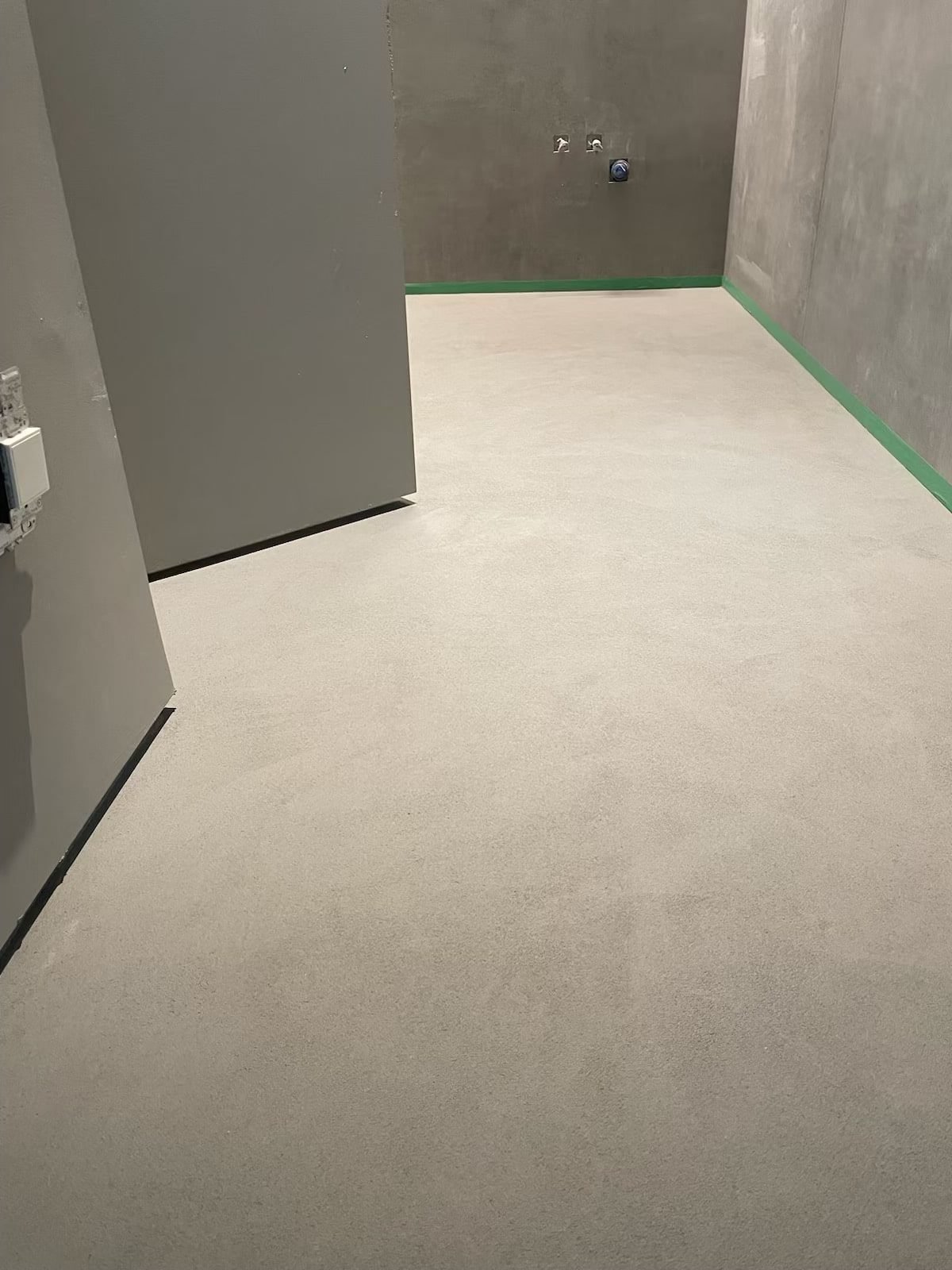
Where can you use concrete effect plaster in a Canadian home?
More places than most people expect. The industrial-concrete aesthetic has moved well beyond loft apartments — it works in full residential settings, and Ottawa homes are no exception.
Common applications:
– Kitchen splashbacks and feature walls — easy to clean once sealed, holds up to grease and steam – Bathroom walls and shower enclosures — waterproof when correctly sealed, seamless look with no grout lines – Living room accent walls — creates a focal point without the weight or permanence of real concrete – Floors — microcement on floors is durable when sealed with a hard-wearing topcoat; works over existing tile or concrete slab – Fireplace surrounds — the finish handles heat well and the aesthetic suits the material – Home offices and commercial interiors — restaurants, retail, wellness studios
Say you’re renovating an open-concept kitchen and you want that poured-concrete look without the structural implications or the cold underfoot — that’s exactly the scenario where microcement earns its place. You get the raw industrial character on the walls and island without reinforcing your floor joists or hiring a structural engineer.
In older Ottawa neighbourhoods — the Glebe, Sandy Hill, Westboro — you’ll often find homes with plaster substrate walls that actually take microcement very well, provided the existing plaster is sound and properly primed.
What to expect during installation: surface prep through final seal
The installation process has more steps than people anticipate, and that’s by design. Rushing any stage compromises the final result.
1. Surface assessment and prep The substrate has to be solid, clean, and free of flex. Loose paint gets removed. Cracks get filled. In wet areas, a waterproofing membrane goes down before anything else. Priming the surface correctly is non-negotiable — it’s what allows the microcement to bond and prevents delamination later.
2. Base coats The first layers of microcement go on with a trowel, building the foundation of the finish. These coats establish the base colour and begin to develop the texture. Each coat cures before the next one goes down.
3. Finish coats The top layers are where the look comes together. Texture, tone variation, and surface character all get refined here. This is skilled trowel work — the artisan’s hand and technique directly affect the result.
4. Sanding between coats Fine sanding between layers keeps the surface flat and helps each subsequent coat bond. This step gets skipped when people try to rush, and it shows.
5. Sealing The sealer is what makes microcement functional, not just decorative. Typically two or more coats of a penetrating or film-forming sealer, with additional product in high-use and wet zones. The sealer choice affects sheen level as well — matte, satin, or semi-gloss options exist.
The full process typically spans multiple days with curing time between stages. Plan for the space to be out of use during that window.
How to maintain a concrete effect plaster finish long-term
Maintenance is genuinely straightforward once the finish is properly sealed. Most of the care questions I get come from people who had a finish applied without adequate sealing — so the starting point matters.
For day-to-day care:
– Wipe with a damp cloth or mild pH-neutral cleaner. No acidic or abrasive products. – Avoid leaving standing water on unsealed edges or areas around fixtures. – Don’t use scrubbing pads or anything abrasive on the surface.
For long-term performance:
– Resealing is the main maintenance task. Depending on traffic and use, floors may benefit from a refreshed topcoat every few years. Walls in dry areas can go much longer without attention. – Watch for wear at high-contact points — around light switches, door edges, countertop edges. These areas can be spot-treated before wear becomes significant. – If the surface gets scratched or chipped, spot repair is usually possible without redoing the whole area, provided the original material and sealer are matched correctly.
The mineral-based nature of these finishes means they don’t peel or blister the way paint does. When they age, they tend to develop character rather than degrade badly — similar to how lime-based finishes behave. A properly installed microcement floor or wall in a Canadian home should give you a decade or more of low-maintenance performance before any real intervention is needed.
Concrete effect plaster is one of those finishes that rewards doing it right the first time. The material system, the prep, the layering, the seal — every step feeds the next one. Done well, it’s a finish that holds up, looks sharp, and ages gracefully.
If you’re thinking about microcement or a concrete effect finish for a wall, floor, bathroom, or kitchen in Ottawa, call me directly at 613-255-1512 or send a note to Info@designerwallfinishes.com. Bring your inspiration photos and tell me about the space — I’ll bring samples so you can see the actual finish in your light, against your materials, before any decisions get made.