
Venetian plaster is a multi-layer, burnished marble finish built up with a steel trowel — it creates depth, translucency, and a sheen that can range from soft satin to near-mirror polish. Limewash is a matte, wash-applied lime coating that dries chalky and cloudy, giving walls a soft, aged, almost weathered quality. Two completely different looks, two completely different techniques — and choosing between them comes down to the mood you’re after, where the wall lives, and how much maintenance you’re willing to do.
What’s the actual difference between Venetian plaster and limewash?
They’re related materials — both are lime-based — but they’re not interchangeable, and the finished result looks nothing alike.
Venetian plaster (stucco veneziano) is made from grassello di calce — slaked lime — combined with crushed marble dust. You apply it in multiple thin layers with a steel trowel, each layer overlapping and compressing the last. Then you burnish it. That burnishing step is what releases the sheen and creates that characteristic depth, where colour seems to sit inside the wall rather than on top of it. Marmorino is the polished, marble-like variation. Grassello di calce produces an even finer, more translucent result. Both take real skill and time.
Limewash is a completely different application method. You’re working with a diluted lime paint — much more liquid — and applying it in thin, overlapping washes with a wide brush. The technique is loose and gestural. You’re building up translucency through layering, but you’re not burnishing, and you’re not compressing the material. The result is matte, cloudy, and intentionally uneven in a way that reads as organic and ancient.
The key material distinction: Venetian plaster becomes structurally part of the wall surface. Limewash sits on the surface as a coating. Both are breathable and VOC-free — that’s the shared DNA of lime — but they behave very differently over time and under conditions.
Which finish looks better — Venetian plaster or limewash?
Neither one looks “better” — they’re answering different design questions entirely.
Venetian plaster reads as luxurious. The polished marble look, the depth you get with marmorino or spatolato technique, the way colour shifts as you move across the wall — it’s a finish that rewards close attention. In a dining room, a lobby, a fireplace surround, it has a presence that flat paint will never replicate. I always tell people: if you want a wall that looks impressive from across the room and up close, Venetian plaster is the answer.
Limewash reads as atmospheric. It’s the finish you’ve seen in Tuscan farmhouses, in aged European churches, in the kind of interiors that feel like they’ve always been there. The cloudy, chalky matte surface creates warmth without weight. It doesn’t demand attention — it just makes a room feel right. If your design direction is organic, rustic, or Scandinavian-meets-Mediterranean, limewash fits naturally.
That tension between “aged farmhouse” and “polished Italian marble” is exactly where this question lives. Some people genuinely can’t decide — they love the rustic warmth they’ve seen on Pinterest, but they also want something that reads luxurious up close. In those cases, I often suggest looking at textured Venetian plaster or a Chelsea limewash finish, which splits the difference: some movement, some depth, but not a full high-polish surface.
One practical note on colour: Venetian plaster gives you more control over depth and saturation. You can achieve very rich, dark tones with real dimension. Limewash tends to lighten as it dries and the effect is more diffused — stunning for pale neutrals and soft earth tones, but harder to work with if you want a deep, saturated result.
How much does Venetian plaster cost compared to limewash in Ottawa?
I’m going to be straight with you: I don’t publish per-square-foot rates, and I’d be skeptical of anyone who does without seeing the wall first.
The price of any artisan finish depends on surface condition, complexity, number of layers, finish type, and access. A smooth new drywall accent wall takes less prep than a textured or damaged existing surface. A multi-layer polished marmorino finish takes more time than a two-coat limewash. Those variables matter more than square footage alone.
What I can tell you is the general relationship: Venetian plaster is typically more expensive than limewash. The materials cost more — we use premium Italian plasters, not domestic box-store substitutes. The application is more technically demanding and time-intensive. Burnishing and sealing add steps. You’re paying for a finish that, when done right, lasts decades and gets harder over time rather than softer.
Limewash is more accessible. It’s still an artisan application — done properly, it’s not something you slap on in an afternoon — but the process is less intensive. That said, there’s a wide quality range in the market. Limewash paint from a hardware store and a proper traditional limewash application with multiple washes and an encausto wax finish are not the same thing. The look is different. The durability is different.
For Ottawa homeowners: call for a consultation and I’ll give you a straight answer based on your actual space. No guessing, no ballpark numbers that don’t mean anything.
Can you use Venetian plaster or limewash in a bathroom or kitchen?
Yes to both — with the right prep and the right sealer.
This is one of the most common questions I get, and the short answer is that lime-based finishes are naturally suited to humid environments if they’re properly sealed. Lime is breathable by nature, which means it manages moisture differently than synthetic coatings. It doesn’t trap humidity behind the surface the way vinyl paint can.
For Venetian plaster in bathrooms: I’d recommend a polished marmorino or grassello finish with a penetrating sealer — not a film-forming sealer that sits on top, but something that bonds with the material. Properly sealed, Venetian plaster is water-resistant and hardwearing. In a shower enclosure, I’d be more cautious — direct water contact for long periods is a different condition than ambient humidity. Around a vanity, on a feature wall, on a ceiling — no problem.
For limewash in bathrooms: Limewash is more porous than polished Venetian plaster, so sealing is non-negotiable in wet areas. A quality wax finish or a compatible topcoat changes the equation considerably. In lower-humidity bathrooms or powder rooms, unsealed limewash can work with proper ventilation. In a steamy main bathroom, seal it.
Kitchens: Both finishes work well in kitchens — the biggest issue is proximity to cooking surfaces. Grease and steam over time will affect any finish. A backsplash area behind a stove gets direct splatter; I’d use a sealed Venetian plaster or tile there. Feature walls further from the cooking zone handle both finishes well.
How durable is each finish — and which one lasts longer?
Properly applied Venetian plaster is harder than drywall compound and outlasts most paint finishes by decades. That’s not marketing — it’s the chemistry. As grassello di calce cures, it undergoes carbonation, literally turning back into calcium carbonate. The surface gets harder over time, not softer. Historic buildings in Europe have Venetian plaster walls that are centuries old. That tells you something.
Limewash is durable in a different way. It’s not hard like polished Venetian plaster — it maintains a slightly chalky, softer surface — but it’s also self-healing in small ways and very easy to touch up. If you nick it or scuff it, blending a repair into limewash is relatively straightforward. With polished Venetian plaster, repairs require matching the material, the colour, and the burnish, which takes skill.
Here’s how I think about durability practically:
– High-traffic walls (hallways, entryways, behind furniture) — Venetian plaster wins. The hardness and abrasion resistance are better. – Feature walls and accent areas with lower physical contact — both finishes perform well long-term. – Touch-up ease — limewash is the winner. A scuff on limewash blends back easily. A scuff on polished marmorino needs an artisan. – Longevity without intervention — properly sealed Venetian plaster. It just keeps going. – Moisture environments — both work sealed; Venetian plaster has more inherent density once burnished and cured.
One thing both finishes share: they’re lime-based and breathable, so they won’t peel, blister, or trap moisture the way synthetic coatings sometimes do on older walls. A lot of older Ottawa homes — the Glebe, Sandy Hill, Westboro — still have original lime plaster walls, and that material has outlasted every layer of latex paint applied on top of it. There’s a reason lime-based finishes have been in continuous use for thousands of years.
Choosing between the two: a quick decision guide
Use this if you’re still deciding.
Choose Venetian plaster if: – You want a luxurious, high-end look with depth and sheen – The space is a dining room, living room, hotel lobby, spa, or commercial interior – You want maximum durability in high-traffic areas – You’re after a specific marble or stone aesthetic – You’re comfortable with artisan pricing for a finish that lasts indefinitely
Choose limewash if: – Your design direction is rustic, organic, farmhouse, or Mediterranea – You want a soft, matte, aged-wall quality – The space is a bedroom, low-traffic living area, or feature wall – You want easier touch-up capability down the line – You’re drawn to the soft, cloudy variation of natural materials
Consider both if: – You’re doing multiple rooms with different moods — Venetian plaster in a formal dining room, limewash in a cosy bedroom – You want a consultation with samples before committing — this is always the right call
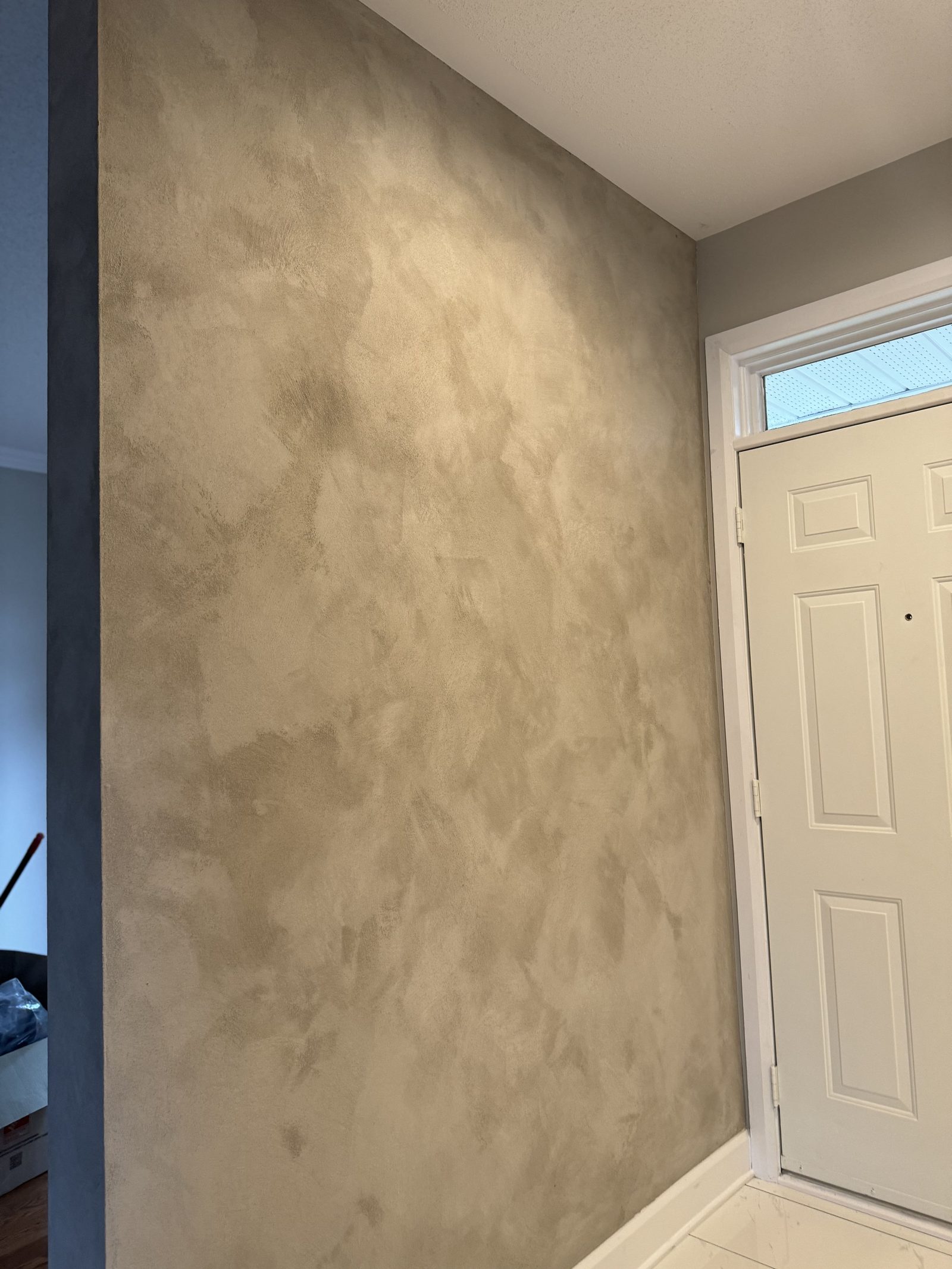
The honest truth is that a lot of people come in convinced they want one and leave ordering the other — or ordering both for different walls. Seeing real samples in your actual lighting makes a bigger difference than any amount of Pinterest browsing.
How Venetian Plaster Ottawa approaches both finishes
I came to this work through material obsession, not a trade school curriculum. My introduction to Venetian plaster was on a trip to Lebanon — I mistook a plastered wall for marble, and that moment sent me down a years-long path of learning from artisans in Australia and North America before I brought the craft back to Ottawa. That background shapes how I work now.
For every project — whether it’s stucco veneziano, marmorino, or a traditional limewash — we start with a consultation and custom colour development. No two spaces are the same. Surface preparation gets as much attention as the finish itself, because the most beautiful plaster will fail if the substrate isn’t right. We source premium Italian materials, not domestic alternatives. And the application — multi-layer, hand-applied with a steel trowel for plaster, or carefully washed and built up for limewash — is done by people who understand what they’re working with.
Ottawa, Westboro, Barrhaven, Kanata, the Glebe, Orleans, Manotick — we work across the region. Residential living rooms, spa environments, restaurant interiors, commercial lobbies. Both finishes. Done properly.
The biggest mistake people make is choosing a finish based only on photos. A photo doesn’t show you how a wall reads under your specific light, at your scale, next to your furnishings. That’s what samples are for.
Call me at 613-255-1512 or email Info@designerwallfinishes.com. Bring your screenshots, your paint swatches, your Pinterest saves — whatever you’re working from. I’ll bring the samples, talk through what works for your wall and your light, and give you a straight recommendation. That’s how decisions like this should get made.